Chapter 5: The Truth Will Set You Free
Chapter 4 gave us collections: values with shape.
Now we need the values that help programs make decisions about that shape.
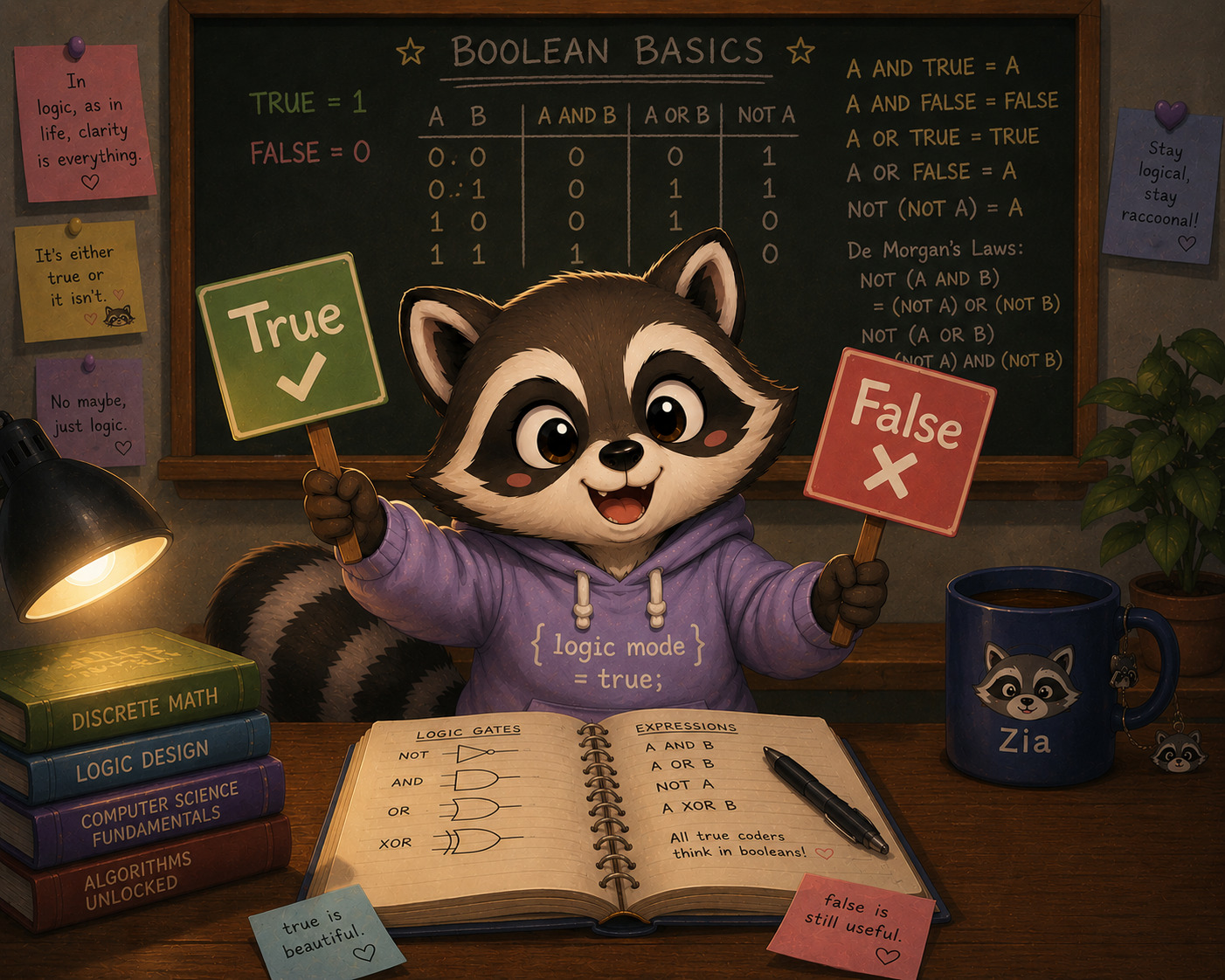
This chapter will introduce you to the final two basic data types in ZuzuScript: Null and Boolean.
5.1 Null
The Null data type only has one possible value: null.
The null value is the value that any variable has before you assign it a value. It can also be assigned explicitly.
let x;
let y := null;

say typeof x;  // says Null
say typeof y;  // says Null
It's not an error or bad practice for some of your variables to simply be null.
But there's not a lot of interesting things to say about null. So we will move on to…
5.2 Boolean
The Boolean data type has two possible values: true and false.
let sky_is_blue           := true;
let vaccines_cause_autism := false;

// Unicode aliases:
let raccoons_are_cute     := ⊤;  // true
let zuzuscript_is_hard    := ⊥;  // false
We've already encountered booleans: most comparison operators (=, eq, subsetof, etc) return them.
let is_admin = ( username eq "zia" );

if ( is_admin ) {
	say "Good morning, Zia!";
}
5.3 Boolean operators
There are a few operators for working with booleans
// NOT
¬ a;       // The opposite of a
not a;     // Same, but easier to type
!a;        // Same, but easier to type and shorter

// AND
a ⋀ b;     // True only if a and b are both true
a and b;   // Same, but easier to type

// NAND
a ⊼ b;     // False only if a and b are both true
a nand b;  // Same, but easier to type

// XOR
a ⊻ b;     // True if exactly one of a and b is true
a xor b;   // Same, but easier to type

// OR
a ⋁ b;     // True if at least one of a and b is true
a or b;    // Same, but easier to type
Combining these operators allow you to build up some quite complex logic.
if ( ( is_weekend or is_holiday ) and ( temperature > 30 ) ) {
	go_to( "the beach" );
}
5.4 Boolean coercion
Much like how numeric operators coerce the values they operate on to numbers and string operators coerce values to string, boolean operators coerce values to Boolean.
nullis coerced tofalse.0is coerced tofalse.- the empty string is coerced to
false. - empty collections are coerced to
false. - objects with a
to_Booleanmethod are coerced by calling the method. - everything else is coerced to
true.
One key thing to notice: the number 0 is coerced to false, but the string "0" is coerced to true.
5.5 The ternary operator
The ternary operator is a widely used logical operator that many programming languages have. The operators we've looked at so far have been unary (working on one value) or binary (working on two values). The ternary operator works on three values.
This operator uses the form c ? a : b. When c is true, the result is a. When c is false, the result is b.
use_template( is_admin ? "admin-dashboard.html" : "dashboard.html" );
It can be thought of as a concise and convenient "if/then/else" expression.
It's possible to chain ternary operators.
let tmpl := is_admin ? "admin.html" : ( logged_in ? "user.html" : "anon.html" );

// Or you could write it as...
let tmpl :=
	is_admin  ? "admin.html" :
	logged_in ? "user.html" :
	"anon.html";
5.6 The Elvis Operator

One common use of the ternary operator is something like this:
let display_name = name ? name : "Anon";
This usage is subtly wrong, or at least often not what you want. Often what we want it to check if name is null. Something like:
let display_name = is_null(name) ? name : "Anon";
ZuzuScript provides a shortcut for this. Imagine collapsing the ? and : of the ternary operator into each other.
let display_name = name ?: "Anon";
This operator is known affectionately as "the Elvis operator".
It is the only operator that is primarily associated with the Null data type.
Elvis assignment
The ?:= operator assigns a value only when the variable currently contains null. If the variable already contains a non-null value, it is left alone.
let display_name;

display_name ?:= "Anon";
display_name ?:= "Zia";

say display_name;  // says "Anon"
This is useful for defaults. You can set a fallback without overwriting a value that was already provided by the user, a config file, or another part of the program.
5.7 Type-Aware comparison operators
We've covered all of Zuzu's basic builtin types (Number, String, BinaryString, Null, and Boolean) as well as collection types (Array, Dict, Set, Bag, and PairList).
We've seen a few different per-type equality operators:
- the
=operator for numbers, - the
eqandeqioperators for strings and binary strings, and - the
⊂⊃orequivalentofoperator for collections
But ZuzuScript also offers a type-aware comparison operator: a ≡ b. This operator:
- if
aandbare different types, then is false. - if
aandbare both null, then is true. - if
aandbare both booleans, then checks they have the same value. - if
aandbare both numbers, then compares them with=. - if
aandbare both strings or binarystrings, then compares them witheq. - if
aandbare both collections, then compares them with⊂⊃. - if
aandbare both objects, then checks they are the same object.
It is your best choice for strictly testing equality.
It has an alternative spelling and an opposite too.
a ≡ b;    // Type-aware equality
a == b;   // Same, but easier to type

a ≢ b;    // Type-aware inequality
a != b;   // Same, but easier to type
5.8 Recap
In this chapter, we covered:
- the
NullandBooleandata types - boolean (logical) operators
- coercion to boolean
- the ternary and Elvis operators
- type-aware equality operators
In Chapter 6, we will put all this learning to work and write some simple practical scripts while learning about control flow. Booleans are the bridge: they are what conditions, loops, and choices listen to.